
VAT Threshold in UAE Explained
Since 2018, businesses in the UAE have been required to follow VAT regulations issued by the Federal Tax Authority.
Since then, businesses across Dubai, Abu Dhabi, Sharjah, and other emirates must follow VAT registration rules set by the Federal Tax Authority.
One of the most important rules is the VAT registration threshold.
Businesses that cross certain revenue limits must register for VAT.
Others can register voluntarily.
Understanding these thresholds helps businesses:
- Avoid penalties
- Stay compliant
- Plan cash flow properly
- Manage invoices correctly
- File VAT returns on time
You can also simplify calculations using this UAE tool:
vat calculator uae
What Is VAT Threshold in UAE?
VAT threshold refers to the minimum taxable turnover a business must reach before VAT registration becomes necessary.
The UAE has two registration categories:
- Mandatory registration
- Voluntary registration
The threshold depends on annual taxable supplies.
Taxable supplies include:
- Goods sold in UAE
- Commercial services
- Online services
- Imports
- Professional services
Businesses must monitor revenue continuously.
If turnover exceeds the required amount, VAT registration becomes compulsory.
The threshold system helps smaller businesses avoid unnecessary compliance costs while ensuring medium and large companies contribute taxes properly.
The UAE government applies VAT at 5%.
Standard VAT rules cover most commercial activities, although some sectors qualify for special tax treatment.
Examples of taxable business sectors:
- Construction
- Retail
- Hospitality
- Logistics
- Consultancy
- IT services
- E-commerce
- Real estate services
Businesses often confuse revenue with profit.
VAT thresholds are based on taxable turnover, not net profit.
That means total eligible sales matter more than earnings after expenses.
Difference Between Mandatory and Voluntary Registration
Mandatory registration means a business is legally required to register for VAT.
Voluntary registration is optional.
Businesses may choose voluntary registration to:
- Improve credibility
- Recover input VAT
- Work with larger corporate clients
- Prepare for future growth
The main difference is the revenue threshold.
Mandatory registration applies after crossing a higher turnover limit.
Voluntary registration applies at a lower limit.
Businesses should evaluate:
- Future growth plans
- Client requirements
- Operational expenses
- Accounting systems
Choosing the right time to register can improve financial planning.
Mandatory VAT Registration Threshold in UAE
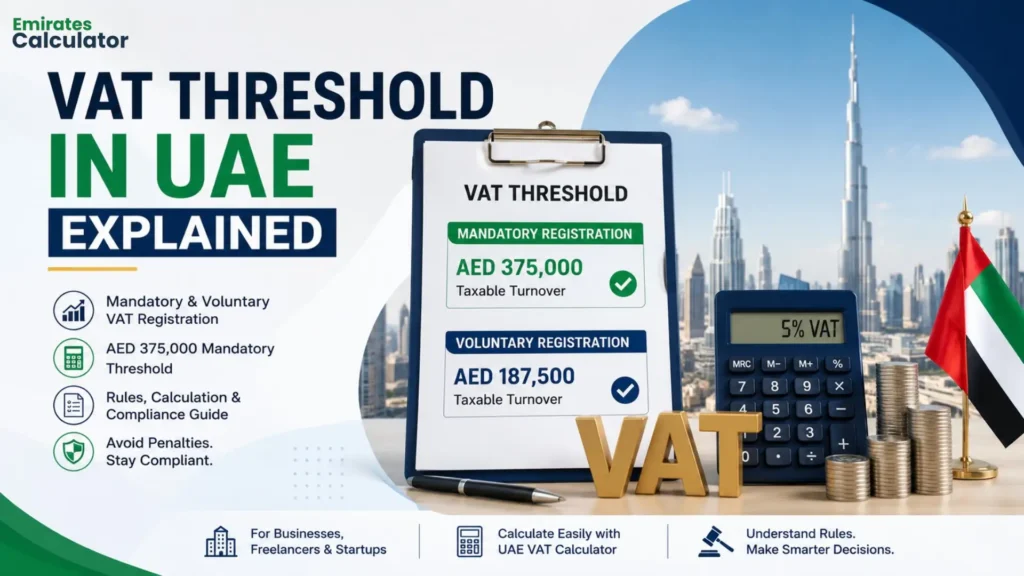
The mandatory VAT registration threshold in UAE is AED 375,000 annually.
If taxable turnover exceeds AED 375,000 within the previous 12 months, registration becomes compulsory.
Businesses must also register if they expect turnover to exceed this limit within the next 30 days.
This rule applies to:
- Mainland businesses
- Free zone companies
- Freelancers
- E-commerce sellers
- Professional service providers
Failing to register on time may result in administrative penalties.
Businesses should track:
- Sales invoices
- Taxable transactions
- Imports
- Revenue forecasts
VAT registration should be completed through the FTA portal.
Companies operating multiple branches under one legal entity usually calculate combined turnover.
The AED 375,000 threshold includes:
- Taxable supplies
- Zero-rated supplies
- Imports
It generally excludes:
- Exempt supplies
- Personal income
- Non-business transactions
Accurate bookkeeping is essential.
Businesses using accounting software usually monitor turnover more efficiently.
Taxable vs Non-Taxable Supplies
Taxable supplies include transactions subject to VAT.
These may be charged at:
- Standard rate (5%)
- Zero rate (0%)
Examples:
- Electronics
- Commercial rent
- Consulting services
- Food services
- Transport services
Exempt supplies are not counted the same way.
Examples may include:
- Certain financial services
- Bare land transactions
- Some residential property transactions
Understanding this distinction prevents incorrect VAT calculations.
Many businesses accidentally overestimate or underestimate taxable turnover because they classify supplies incorrectly.
Professional accounting support can reduce compliance risks.
Voluntary VAT Registration Threshold in UAE
The voluntary VAT registration threshold is AED 187,500.
Businesses below the mandatory threshold but above AED 187,500 can choose to register voluntarily.
This option is useful for:
- Startups
- SMEs
- Freelancers
- Growing businesses
Voluntary registration offers several advantages.
Businesses can recover VAT paid on:
- Office rent
- Equipment
- Fuel
- Marketing
- Professional services
It also improves trust with larger clients.
Some corporations prefer working only with VAT-registered suppliers.
Voluntary registration can also help businesses prepare operational systems early.
However, VAT registration increases compliance responsibilities.
Businesses must:
- File VAT returns
- Maintain accounting records
- Issue VAT invoices
- Track input and output VAT
Small businesses should compare compliance costs against financial benefits before registering.
VAT Threshold for Freelancers and Startups
Freelancers in UAE are subject to the same VAT rules as companies.
If annual taxable turnover exceeds AED 375,000, VAT registration becomes mandatory.
Examples include:
- Marketing consultants
- Designers
- Developers
- Trainers
- Social media managers
Startups should monitor projected revenue carefully.
Rapid growth can trigger VAT registration earlier than expected.
Many startups voluntarily register to recover setup costs.
This may include:
- Software subscriptions
- Office setup
- Advertising expenses
- Equipment purchases
Accurate invoicing systems become important from the beginning.
How to Calculate Taxable Turnover in UAE
Taxable turnover includes all eligible taxable sales within a 12-month period.
Businesses should calculate:
- Standard-rated supplies
- Zero-rated supplies
- Imports
Formula example:
Taxable Turnover=Total Taxable Sales+Zero-Rated Supplies+Imports
Example:
- Sales revenue: AED 300,000
- Zero-rated exports: AED 50,000
- Imports: AED 40,000
Total taxable turnover:
AED 390,000
In this case, VAT registration becomes mandatory.
Businesses should maintain:
- Sales records
- Import documents
- Tax invoices
- Credit notes
Using spreadsheets or accounting software reduces calculation errors.
Manual calculations often lead to missed reporting obligations.
You can simplify VAT computations using:
vat calculator uae
How FTA Reviews VAT Applications
The FTA reviews:
- Trade license
- Emirates ID or passport
- Revenue details
- Banking information
- Business activities
Incorrect or incomplete applications may face delays.
Businesses should ensure:
- Revenue figures are accurate
- Documents are updated
- Contact details are valid
The FTA may request additional information before approval.
Once approved, businesses receive:
- VAT registration number (TRN)
- VAT certificate
Who Needs to Register for VAT in UAE?
Businesses exceeding the threshold must register.
Common sectors include:
- Construction companies
- Retail stores
- Restaurants
- Consultancy firms
- E-commerce sellers
- Logistics providers
- IT companies
Freelancers and self-employed professionals may also qualify.
Foreign businesses supplying taxable goods or services in UAE may have separate VAT obligations.
Companies should regularly review:
- Revenue trends
- Future contracts
- Expansion plans
Late registration creates financial risk.
Businesses often underestimate future growth and miss deadlines.
Penalties for Not Registering for VAT
Failure to register for VAT can result in administrative penalties.
Possible consequences include:
- Financial fines
- Delayed VAT recovery
- Compliance investigations
- Business reputation damage
Businesses may also face:
- Incorrect tax reporting
- Interest liabilities
- Audit complications
Maintaining proper records reduces these risks.
VAT compliance should be treated as a regular business process rather than a one-time task.
Benefits of VAT Registration for Businesses
VAT registration offers several business advantages.
Key benefits include:
- Recovering input VAT
- Improved business credibility
- Better accounting systems
- Increased corporate trust
- Easier financial tracking
Registered businesses can claim VAT on eligible operational expenses.
This may reduce overall business costs.
VAT registration also encourages stronger bookkeeping practices.
Companies with organized financial records often make better operational decisions.
Common VAT Registration Mistakes
Many businesses make avoidable VAT errors.
Common issues include:
- Missing threshold calculations
- Incorrect invoice formatting
- Late registration
- Poor recordkeeping
- Ignoring zero-rated supplies
Businesses should review turnover monthly.
Accounting software can automate many VAT-related tasks.
Professional guidance may help businesses avoid compliance penalties.
How to Register for VAT in UAE
VAT registration happens online through the FTA portal.
Typical steps:
- Create FTA account
- Submit business details
- Upload documents
- Provide revenue information
- Submit application
Required documents may include:
- Trade license
- Passport copy
- Emirates ID
- Financial statements
- Bank details
Approval timelines vary depending on application accuracy.
Documents Required for VAT Registration
Businesses usually prepare:
- Trade license
- MOA documents
- Revenue proof
- Bank account details
- Authorized signatory documents
Clear documentation speeds up approval.
Businesses should keep digital copies ready before starting the application.
Use a VAT Calculator UAE for Faster Calculations
VAT calculations can become confusing when handling:
- Inclusive VAT
- Exclusive VAT
- Multiple invoices
- Discounts
- Imports
An online calculator reduces errors.
Benefits include:
- Faster VAT calculations
- Accurate tax estimates
- Simple invoice breakdowns
- Time savings
Use this free tool:
vat calculator uae
It helps businesses quickly calculate:
- VAT amount
- Net amount
- Gross amount
- 5% UAE VAT
This is useful for:
- SMEs
- Freelancers
- Retailers
- Accountants
- E-commerce sellers
Final Thoughts
Understanding VAT thresholds in UAE is essential for every business.
Correct VAT registration helps companies:
- Stay compliant
- Avoid penalties
- Improve financial planning
- Build credibility
Businesses should regularly monitor taxable turnover and maintain accurate records.
Using tools like a UAE VAT calculator can simplify daily calculations and improve accuracy.
For fast VAT calculations, try:
vat calculator uae

What Is an E-Signature Card in the UAE? Complete Guide for Businesses
What Is an E-Signature Card in the UAE? Complete Guide...
Read More

Gratuity Eligibility Criteria in UAE: Who Can Claim?
Gratuity Eligibility Criteria in UAE: Who Can Claim? For employees...
Read More

UAE Announces Hijri New Year Holiday 2026: Everything You Need to Know
UAE Announces Hijri New Year Holiday 2026: Everything You Need...
Read More
What Are the 5 Daily Prayer Times in Islam?
What Are the 5 Daily Prayer Times in Islam? Prayer,...
Read More