
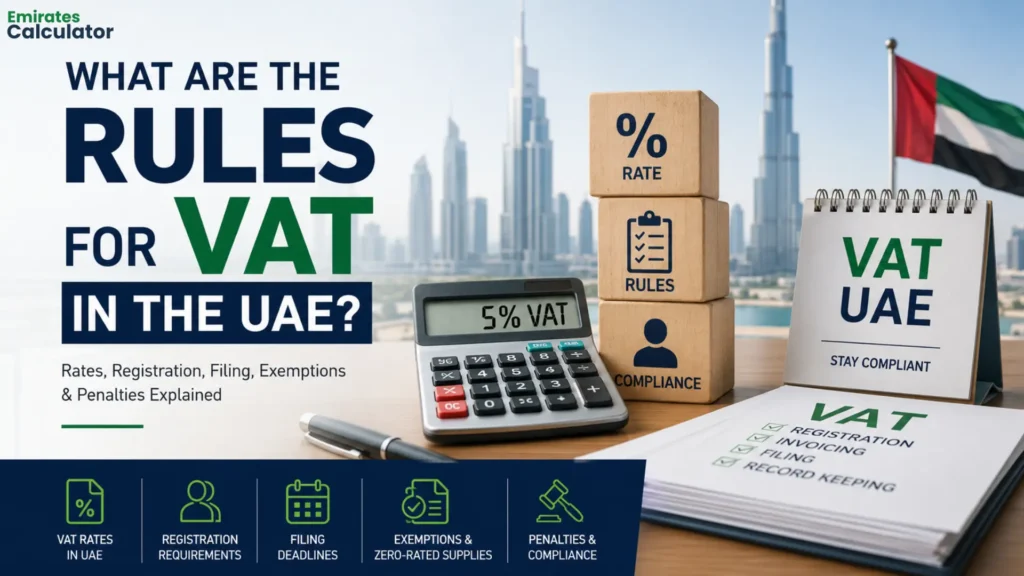
What Are the Rules for VAT in the UAE?
The UAE introduced Value Added Tax (VAT) on January 1, 2018.
VAT applies to most goods and services sold in the country. The standard VAT rate is 5%.
Businesses operating in the UAE must understand VAT rules to avoid penalties and maintain compliance with the Federal Tax Authority (FTA).
This guide explains:
- VAT rates
- Registration requirements
- Filing obligations
- Exemptions
- Penalties
- VAT calculation methods
You will also learn how to simplify tax calculations using a VAT Calculator UAE.
What Is VAT in the UAE?
VAT in the UAE is applied to most commercial transactions involving products and services.
Companies add VAT to eligible sales, collect the amount from buyers, and transfer it to the tax authority during filing periods.
The UAE applies a standard VAT rate of 5% on most taxable supplies.
VAT supports government revenue while reducing dependence on oil income.
The system is regulated by the Federal Tax Authority UAE.
VAT applies to:
- Retail sales
- Professional services
- Hospitality
- Construction
- E-commerce
- Imports
Some sectors qualify for zero-rated or exempt treatment.
Businesses registered for VAT must:
- Charge VAT correctly
- Keep accounting records
- Submit VAT returns
- Pay VAT on time
Consumers ultimately bear the tax cost.
For example:
If a product costs AED 100, the business adds 5% VAT. The customer pays AED 105.
VAT compliance is mandatory for eligible businesses operating in the UAE mainland and free zones that fall under VAT regulations.
Companies should maintain accurate invoices and bookkeeping systems to avoid reporting errors.
Digital tools now simplify VAT tracking and reporting.
A reliable VAT Calculator UAE helps businesses instantly calculate VAT-inclusive and VAT-exclusive prices.
Who Needs to Register for VAT in UAE?
VAT registration depends on annual taxable turnover.
Businesses exceeding the mandatory threshold must register with the FTA.
Mandatory VAT Registration Threshold
Businesses must register for VAT if taxable supplies exceed AED 375,000 annually.
This includes:
- Goods sold
- Services provided
- Imports
- Taxable expenses
Failure to register can result in fines.
Businesses should monitor revenue regularly to avoid missing registration deadlines.
Companies expecting to cross the threshold within 30 days must also register.
Registration is completed online through the FTA portal.
Required documents usually include:
- Trade license
- Emirates ID or passport
- Financial statements
- Business turnover details
VAT registration gives businesses a Tax Registration Number (TRN).
The TRN must appear on tax invoices and official VAT documents.
Voluntary VAT Registration
Businesses with taxable supplies above AED 187,500 may register voluntarily.
Voluntary registration benefits:
- Improved business credibility
- Recovery of input VAT
- Better financial documentation
Startups and freelancers often choose voluntary registration when dealing with VAT-registered clients.
Businesses below the threshold are generally not required to register.
However, they must still maintain proper accounting records.
What Is the VAT Rate in the UAE?
The standard VAT rate in the UAE is 5%.
This rate applies to most goods and services.
Compared to many countries, the UAE maintains one of the lowest VAT rates globally.
Examples of taxable supplies:
- Electronics
- Restaurant services
- Consultancy services
- Commercial property
- Online subscriptions
Some goods and services qualify for different VAT treatment.
VAT on Imports and Exports
Imports are generally subject to VAT.
Businesses importing goods into the UAE may recover input VAT if properly registered.
Exports outside GCC implementing states are usually zero-rated.
This helps UAE businesses remain competitive internationally.
Certain sectors also receive zero-rated treatment:
- International transportation
- Newly constructed residential properties
- Education under specific conditions
- Healthcare under approved categories
Businesses should verify VAT classifications carefully.
Incorrect VAT treatment can trigger penalties and audits.
The FTA may request supporting documents during inspections.
Using automated accounting software reduces classification mistakes.
Zero-Rated vs Exempt Supplies in UAE VAT
Many businesses confuse zero-rated and exempt supplies.
The difference affects VAT recovery.
Zero-rated supplies carry 0% VAT, but businesses can still reclaim input VAT.
Exempt supplies do not charge VAT, and input VAT recovery is generally not allowed.
Examples of zero-rated supplies:
- International transport
- Exported goods
- Certain educational services
- Qualified healthcare services
Examples of exempt supplies:
- Bare land
- Local passenger transport
- Some financial services
- Residential properties after first supply
Understanding these categories is critical for accurate VAT filing.
Misclassification may increase tax liability.
Businesses should review invoices and contracts carefully before applying VAT treatment.
Professional accounting support may help businesses handling mixed supplies.
Companies should also maintain documentation proving eligibility for zero-rating or exemptions.
FTA audits often focus on supporting evidence.
How VAT Is Calculated in the UAE
VAT calculation is straightforward when using the correct formula.
Input VAT and Output VAT
Output VAT is the VAT charged to customers.
Input VAT refers to the tax a business pays when purchasing goods, services, or operational expenses for business use.
VAT payable equals:
Output VAT – Input VAT
Example:
- Output VAT collected: AED 10,000
- Input VAT paid: AED 6,000
- VAT payable: AED 4,000
Businesses can recover eligible input VAT through VAT returns.
Accurate bookkeeping is essential.
Errors in calculations may lead to penalties or delayed refunds.
For VAT-inclusive pricing:
VAT Amount = Inclusive Price × 5 ÷ 105
For VAT-exclusive pricing:
VAT Amount = Price × 5%
Manual calculations increase the risk of mistakes.
A VAT Calculator UAE provides faster and more accurate results.
These tools help businesses:
- Calculate VAT instantly
- Generate accurate figures
- Reduce accounting errors
- Improve invoice accuracy
VAT Filing Rules and Deadlines
VAT-registered businesses must file VAT returns regularly.
The FTA assigns filing periods:
- Monthly
- Quarterly
Most small businesses file quarterly.
VAT returns include:
- Sales
- Purchases
- VAT collected
- VAT recoverable
Businesses must submit returns before the deadline shown in the FTA portal.
Late filing can trigger administrative penalties.
Tax Invoices and Record Keeping
VAT-registered businesses must issue tax invoices.
Invoices should include:
- TRN
- Invoice number
- VAT amount
- Supplier details
- Customer details where applicable
Businesses must maintain records for at least five years.
Required records include:
- Purchase invoices
- Sales invoices
- Credit notes
- Debit notes
- Import documents
Digital accounting systems simplify storage and retrieval.
Well-organized records help businesses during audits and VAT reviews.
Companies should regularly reconcile VAT reports with accounting records.
VAT Penalties in the UAE
The UAE applies strict VAT penalties for non-compliance.
Common violations include:
- Late registration
- Late filing
- Incorrect VAT returns
- Failure to maintain records
- Tax evasion
Penalties vary depending on the offense.
Repeated violations may result in higher fines.
Businesses should implement internal controls to reduce risks.
Common VAT Mistakes Businesses Make
Frequent mistakes include:
- Charging incorrect VAT rates
- Missing filing deadlines
- Claiming invalid input VAT
- Poor invoice management
- Misclassifying exempt supplies
Many businesses also fail to reconcile VAT returns before submission.
Simple errors can create large financial liabilities over time.
Regular accounting reviews help identify mistakes early.
Using automated systems and VAT calculators improves reporting accuracy.
Businesses should also train finance staff on current UAE VAT regulations.
VAT Rules for Freelancers and Small Businesses
Freelancers must comply with VAT rules if annual taxable turnover exceeds the registration threshold.
Many consultants, designers, developers, and online sellers fall under VAT regulations.
Small businesses should monitor revenue consistently.
Voluntary registration may benefit growing businesses seeking input VAT recovery.
Freelancers should:
- Issue VAT invoices
- Track expenses
- Maintain financial records
- File VAT returns on time
Businesses operating in UAE free zones may still fall under VAT regulations depending on the type of activity and the zone classification.
VAT treatment depends on business activity and designated zone classification.
Professional bookkeeping support helps small businesses avoid compliance issues.
Cloud accounting tools make VAT tracking easier and more affordable.
How Businesses Can Stay VAT Compliant
VAT compliance reduces legal and financial risks.
Businesses should:
- Maintain accurate accounts
- File VAT returns before deadlines
- Review invoices carefully
- Reconcile VAT records monthly
- Monitor VAT law updates
Regular audits improve accuracy.
Companies should also create internal approval processes for VAT reporting.
Benefits of Digital VAT Tools
Digital VAT tools improve:
- Speed
- Accuracy
- Compliance
- Reporting efficiency
Businesses using automated systems reduce manual errors significantly.
A trusted VAT Calculator UAE simplifies VAT calculations for businesses and individuals.
These tools are especially useful for:
- SMEs
- Freelancers
- Online sellers
- Accountants
- Retail businesses
Accurate calculations help businesses maintain better financial records and avoid disputes.
Why Using a VAT Calculator UAE Saves Time
Manual VAT calculations take time and increase error risk.
An online VAT calculator provides instant and accurate figures.
Benefits include:
- Fast calculations
- Reduced mistakes
- Improved invoice accuracy
- Better tax planning
- Time savings
Businesses handling large transaction volumes benefit most from automated calculations.
A reliable VAT Calculator UAE helps users calculate:
- VAT-inclusive prices
- VAT-exclusive prices
- VAT amounts payable
- Net costs
The tool supports businesses, freelancers, and consumers across the UAE.
Using digital tools alongside proper accounting practices improves overall VAT compliance.
Final Thoughts
Understanding VAT rules in the UAE is essential for businesses of all sizes.
Companies must:
- Register when required
- Apply correct VAT rates
- File returns on time
- Maintain proper records
Failure to comply may result in significant penalties.
Businesses can simplify VAT management with accurate accounting systems and digital tools.
For quick and accurate calculations, use the VAT Calculator UAE.
For official VAT guidance, visit the Federal Tax Authority UAE.

What Is an E-Signature Card in the UAE? Complete Guide for Businesses
What Is an E-Signature Card in the UAE? Complete Guide...
Read More

Gratuity Eligibility Criteria in UAE: Who Can Claim?
Gratuity Eligibility Criteria in UAE: Who Can Claim? For employees...
Read More

UAE Announces Hijri New Year Holiday 2026: Everything You Need to Know
UAE Announces Hijri New Year Holiday 2026: Everything You Need...
Read More
What Are the 5 Daily Prayer Times in Islam?
What Are the 5 Daily Prayer Times in Islam? Prayer,...
Read More