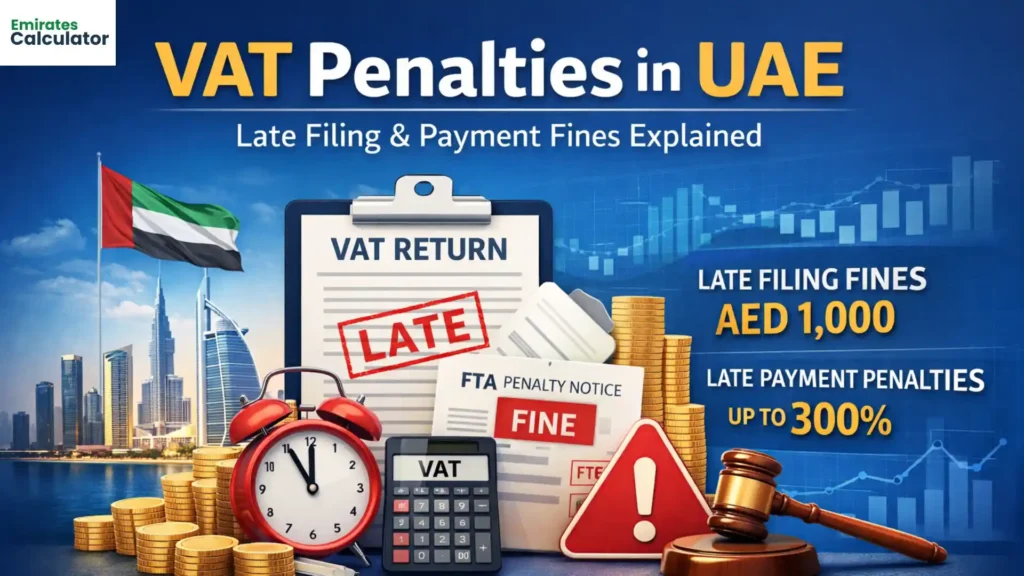
VAT Penalties in UAE: Late Filing & Payment Fines Explained
VAT compliance in the United Arab Emirates is strict.
Missing deadlines can result in heavy penalties.
This guide explains late filing fines, late payment charges, and how to reduce risk.
It is designed to support users of our online vat calculator uae tool.
1. Overview of VAT Penalties in UAE
VAT penalties are administrative fines imposed on businesses that fail to comply with tax regulations.
The authority responsible for enforcement is the Federal Tax Authority (FTA).
Penalties apply to:
The penalty system is structured and progressive.
Repeated violations increase the financial burden.
For SMEs and startups, even small delays can lead to serious cash flow problems.
Businesses must understand both fixed and percentage-based fines.
Being proactive prevents unnecessary financial loss.
Role of the Federal Tax Authority (FTA)
The Federal Tax Authority administers VAT law in the UAE.
It monitors tax returns, payments, and compliance records.
The FTA can:
All penalties are published in official administrative penalty decisions.
Businesses should review FTA updates regularly.
Official reference: Federal Tax Authority website.
Why VAT Compliance Matters
Non-compliance affects:
Repeated violations increase audit risk.
Compliance protects long-term business stability.
It also ensures accurate VAT recovery on expenses.
2. UAE VAT Late Filing Penalties
Businesses are required to submit their VAT returns within 28 days after the end of each tax period.
Late submission triggers automatic fines.
Even one-day delay counts as non-compliance.
The penalty is administrative and does not depend on VAT amount due.
Businesses must track deadlines carefully.
Using reminders or accounting software reduces risk.
Fixed Penalties for Late Filing
Late filing penalty structure:
The system escalates quickly.
Repeated delays signal compliance weakness.
Even if no VAT is payable, the fine still applies.
Zero-return businesses are not exempt.
Repeated Offences and Increased Fines
If delays continue:
Chronic non-compliance affects credit credibility.
Maintaining a filing calendar is essential.
3. UAE VAT Late Payment Penalties
Late payment penalties are more severe than late filing.
They include fixed and percentage-based components.
The structure includes:
2% of unpaid tax immediately after due date
4% additional penalty after 7 days
1% daily penalty after one month (up to 300%)
These penalties compound quickly.
Large liabilities become expensive within weeks.
Cash flow planning is critical.
Initial Late Payment Fine
The first penalty is 2% of unpaid VAT.
If VAT due is AED 100,000:
Initial fine = AED 2,000
If unpaid after 7 days:
Additional 4% = AED 4,000
Total so far = AED 6,000
This happens before daily penalties begin.
Daily Accumulated Penalties
After 30 days:
1% daily penalty applies.
This continues until:
Full payment is made
Maximum cap is reached
This structure encourages immediate settlement.
Delays multiply liabilities rapidly.
4. Other VAT-Related Penalties in UAE
Late filing and payment are not the only risks.
Other administrative penalties include:
Failure to register for VAT
Incorrect VAT return
Failure to issue tax invoice
Failure to maintain records
Each violation has defined fines.
Businesses must review compliance obligations fully.
Incorrect VAT Return Submission
Errors in VAT returns can result in penalties.
Common issues:
If errors reduce tax payable, penalties increase.
Voluntary disclosure reduces financial impact.
Accuracy is essential.
Failure to Register or Deregister
Businesses crossing the VAT threshold must register.
Failure to register may lead to penalties up to AED 20,000.
Failure to deregister when required also triggers fines.
Monitor revenue thresholds regularly.
5. How to Avoid VAT Penalties in UAE
Prevention is simpler than correction.
Businesses should implement:
Assign VAT responsibility clearly within the company.
Documentation must be updated monthly.
Use Digital Tools and Reminders
Automated reminders reduce missed deadlines.
Cloud accounting tools improve visibility.
Set alerts 7 days before due date.
Always review VAT payable before submission.
Maintain Proper VAT Records
Maintain records for at least 5 years.
Store:
Tax invoices
Import documents
Credit notes
Payment confirmations
Proper documentation reduces audit risk.
6. How to Calculate VAT Liabilities and Avoid Fines
Many penalties happen due to miscalculation.
Estimate VAT before filing.
Compare output VAT vs input VAT.
Prepare funds in advance.
Do not wait until deadline day.
Estimating VAT Before Filing
Monthly internal review helps.
Reconcile:
Identify discrepancies early.
Correct errors before submission.
Using an Emirates Calculator Online VAT Calculator UAE
To reduce mistakes, use Emirates Calculator
online vat calculator uae
It helps you:
This reduces risk of incorrect return submission.
It supports accurate planning.
Combine the calculator with proper bookkeeping for best results.
Final Summary
VAT penalties in the UAE are structured and strict.
Late filing triggers fixed fines.
Late payment triggers percentage-based penalties that grow daily.
Repeated violations increase risk and cost.
Use compliance systems.
Estimate VAT early.
Leverage our online vat calculator uae tool to reduce errors and prevent unnecessary fines.
Accurate filing protects business stability and financial health.